Introduction
Academic libraries love data. Reference transaction data is essential to how academic libraries function, we’re told; the aggregated number of questions answered helps justify the institutional budget. The material reality of this means that librarians spend time logging what they do—the questions they answer must be entered and collected.
With these collected data points, I made a quilt. I was drawn to the idea of using a traditionally feminine handicraft to represent traditionally feminine labor. I say this with full awareness that non-feminine individuals are also quilters and librarians—but I am aware of the demographics of both disciplines and aware of vague stigmas surrounding them.
Beginning this undertaking, I knew the quilt would not be a perfect product. I am new to quilting, and I knew there would be mistakes. Stitches, which are supposed to be hidden, would definitely be visible. But this flawed product would highlight my goal: I wanted to make the messy, yet invisible labor of answering reference queries visible again.
I am one of several Research & Instruction Librarians at Fairleigh Dickinson University (FDU). We are a small team in a mid-size academic library, and we take turns sitting at the reference desk and responding to online chats. My colleagues and I are urged to fill out the transaction form for every reference interaction we have, from “How do I print?” to “Can you help me find open educational resources about HR practices from the last five years with a focus on North America?” (Both are real questions that appear in the quilt.) We collect data for every question we receive, but what happens to that data afterward? It gets anonymized and sanitized and reported. We don’t look back at individual reference transaction data from semesters past. With this project, I am arguing that maybe we should—to help us understand more about the work we do.
Methods & Patterns
At FDU, we classify questions as “directional/technical assistance,” “transaction,” or “consultation.” We include other data with each of these interactions, such as the type of patron, the length of the interaction, and the academic area to which the question pertained. This was great data for the library, but for my purposes, I needed to split it into further categories to be able to create an interesting quilt. About a week and a half into the semester, I devised the following nine categories for my data:
- Faculty or staff request resources
- Requests for “stuff”
- Asking about directions
- Asking about hours or access
- Printing, scanning, and copying
- Requests for books
- Basic “how to search” help
- Website or technology issues
- Students request resources
To illustrate this a little better, here’s an example of each category.
- Can you get me access to all issues of this journal?
- Can I borrow a pen?
- Where is the athletics advising center?
- How late is the library open?
- How do I print?
- Do you have any copies of The Handmaid’s Tale?
- How do I look something up in the catalog?
- How do I access the software on the computers?
- Can you help me find information on mental health in college?
With my categories set, it was time to pick out fabric. I chose vibrant and geometric patterns. Stripes, splatters, triangles, diamonds—all in pinks and purples and blues. Would it have been simpler to pick solid colors, ones that easily stood out from one another? Sure. However, the messy nature of this data is something I wanted to embrace. I didn’t want the quilt to be easy on the eyes. Colorful, brash patterns complicate reading the quilt, make it harder to deduce patterns. I wanted anyone who viewed the quilt to spend time with it. The wild fabric patterns facilitate that.
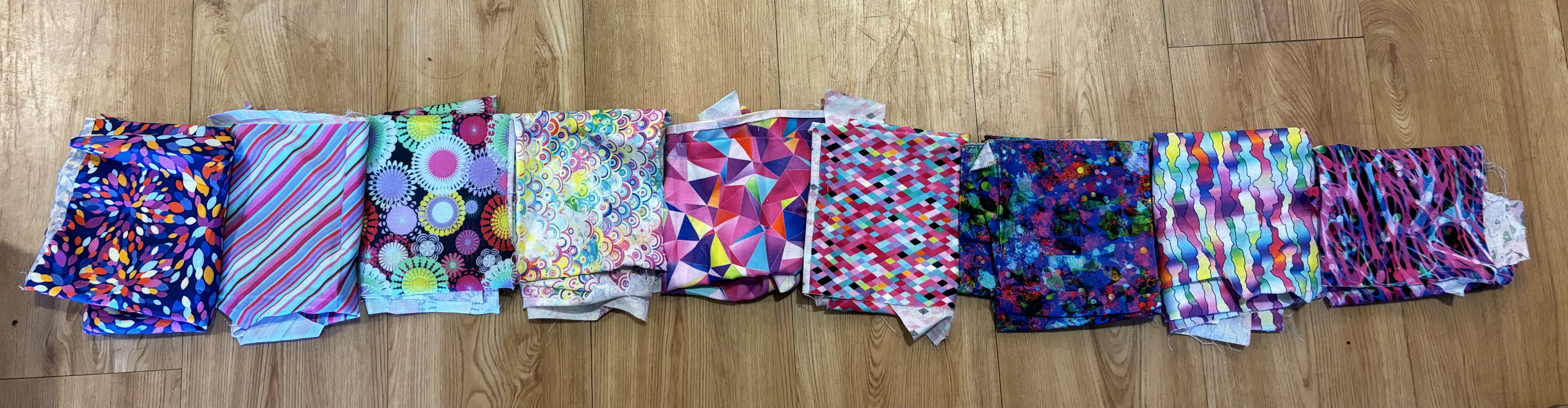
Fabric patterns 1 through 9, in order.
I learned English paper piecing (EPP) as a quilting method a few weeks before the semester started at the #dhmakes mini-conference at DH2024. I was enamored by how easy it was—the fabric and paper came together at a surprising pace, and I found myself in a flow state while working. The process was meditative. I looked forward to integrating it into my research.
For those unfamiliar with EPP, it involves a paper shape—in my case, a hexagon. Fabric is wrapped around the hexagon and sewn into place. The thread never goes through the paper, though—you sew the fabric to itself until it forms a hexagonal shape. Once you have multiple fabric/paper hexagons, you sew them together and remove the paper from the backside of the quilt.
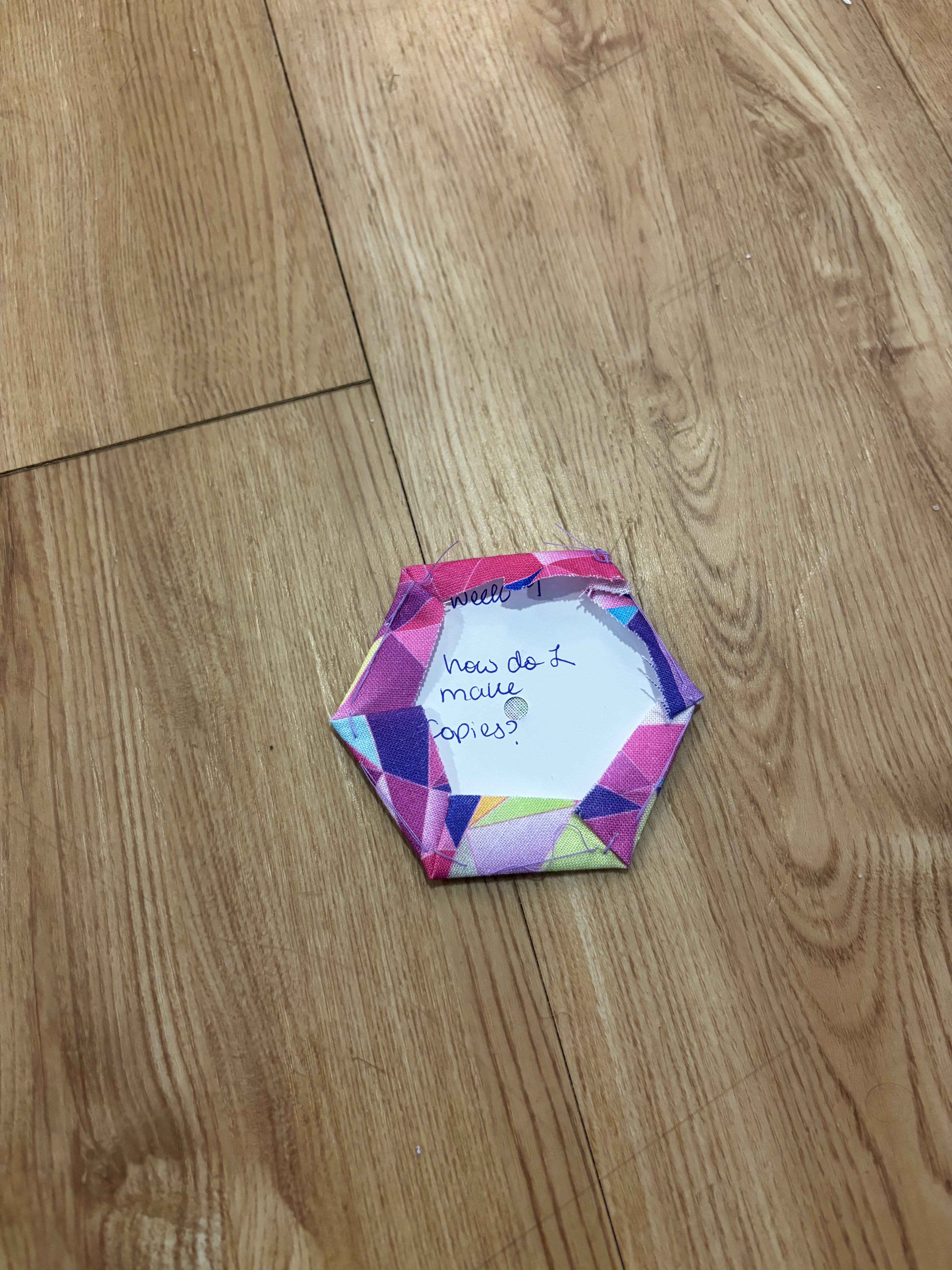
A single hexagon from the quilt, showing the paper piece inside.
I decided that I wanted to write the reference questions on the paper hexagons themselves, creating a handwritten, hand-quilted record of the semester. On each paper hexagon, there’s the week #, pattern #, and question itself. I consider the paper hexagons, even removed from the quilt, as a part of this project. When the quilt is complete, they’ll be strung together on a cord and placed next to the quilt as a way of “browsing” it. Viewers should be able to place the paper hexagon on a corresponding fabric one.
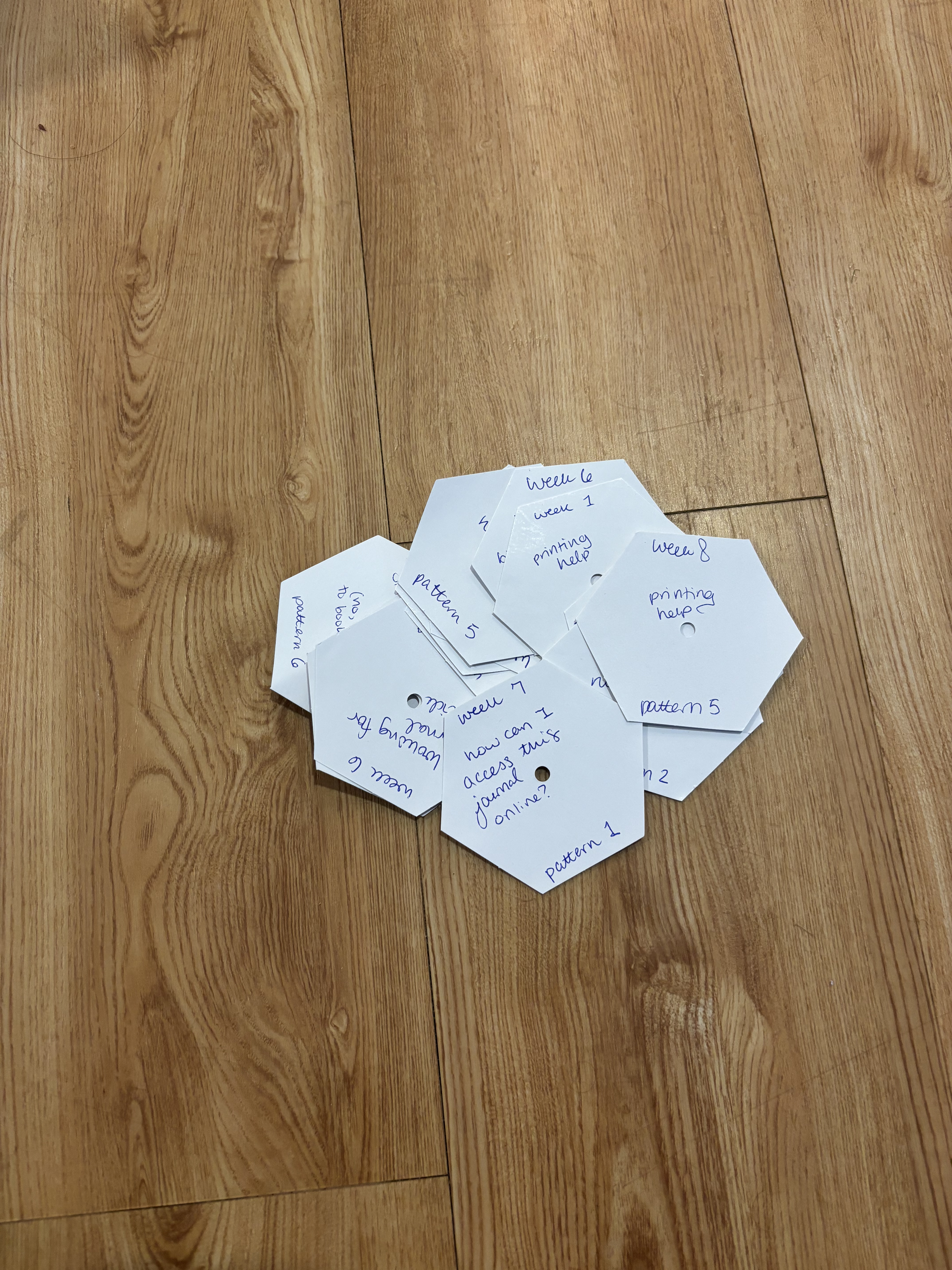
A pile of paper hexagons with reference questions.
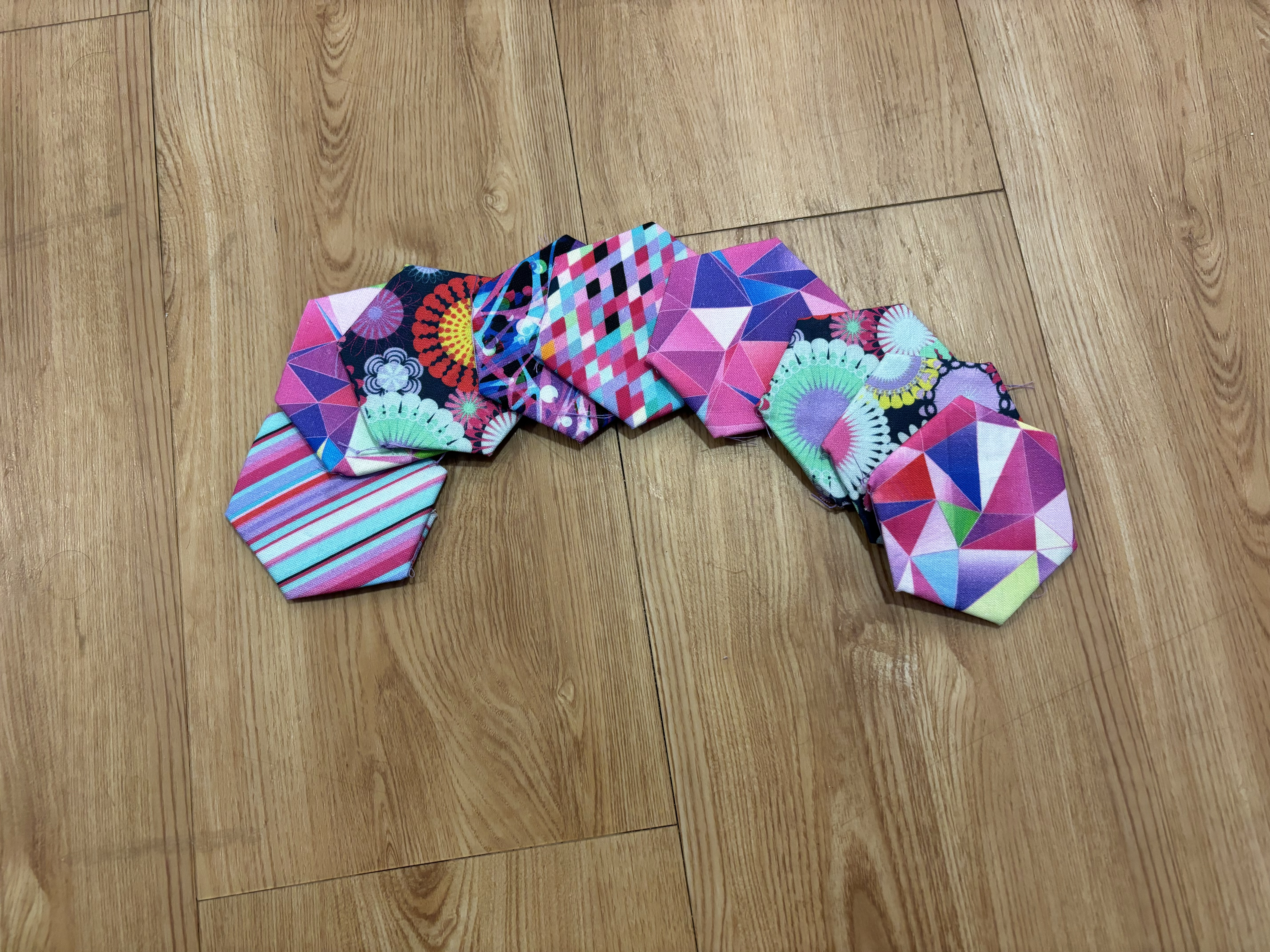
Week 9’s reference transactions, ready to be stitched together.
Results & Lessons
Over the course of the Fall 2024 semester, from August 26 to December 20, I recorded 200 reference questions. I had to buy a second pack of paper hexagons a few weeks into the semester. Then a third. I was not wholly prepared for the number of questions; I started my job over the summer.
I feel the need to disclaim that, due to the volume of reference questions, my librarian duties, and the rest of my non-work life, the quilt is not yet complete. As of my first draft, I have quilted 9 of 17 weeks and begun work on the 10th. As of publication, I hope to have my questions quilted through week 12 of the Fall 2024 semester. One could question if an incomplete quilt is a quilt at all—this one currently has no backing, for example, as I’m waiting until I complete the top to add backing fabric. I argue it’s still a quilt, even if it’s a quilt in potentia. It is, at the very least, a quilted handicraft, and one I’m quite proud of.
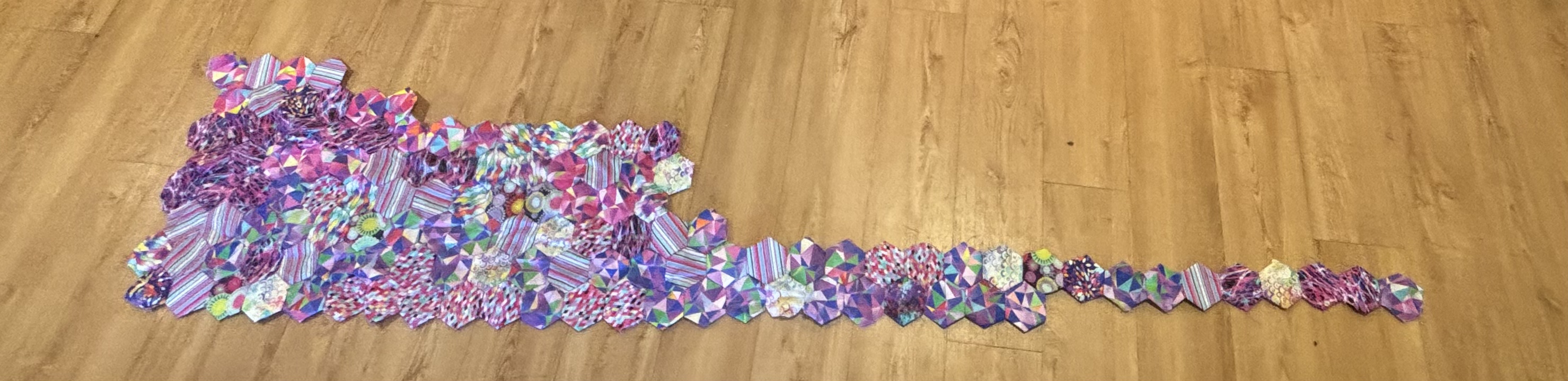
The partly-completed quilt, showing weeks 1 through 8. Week 1 is at the bottom of the image and week 8 is at the top.
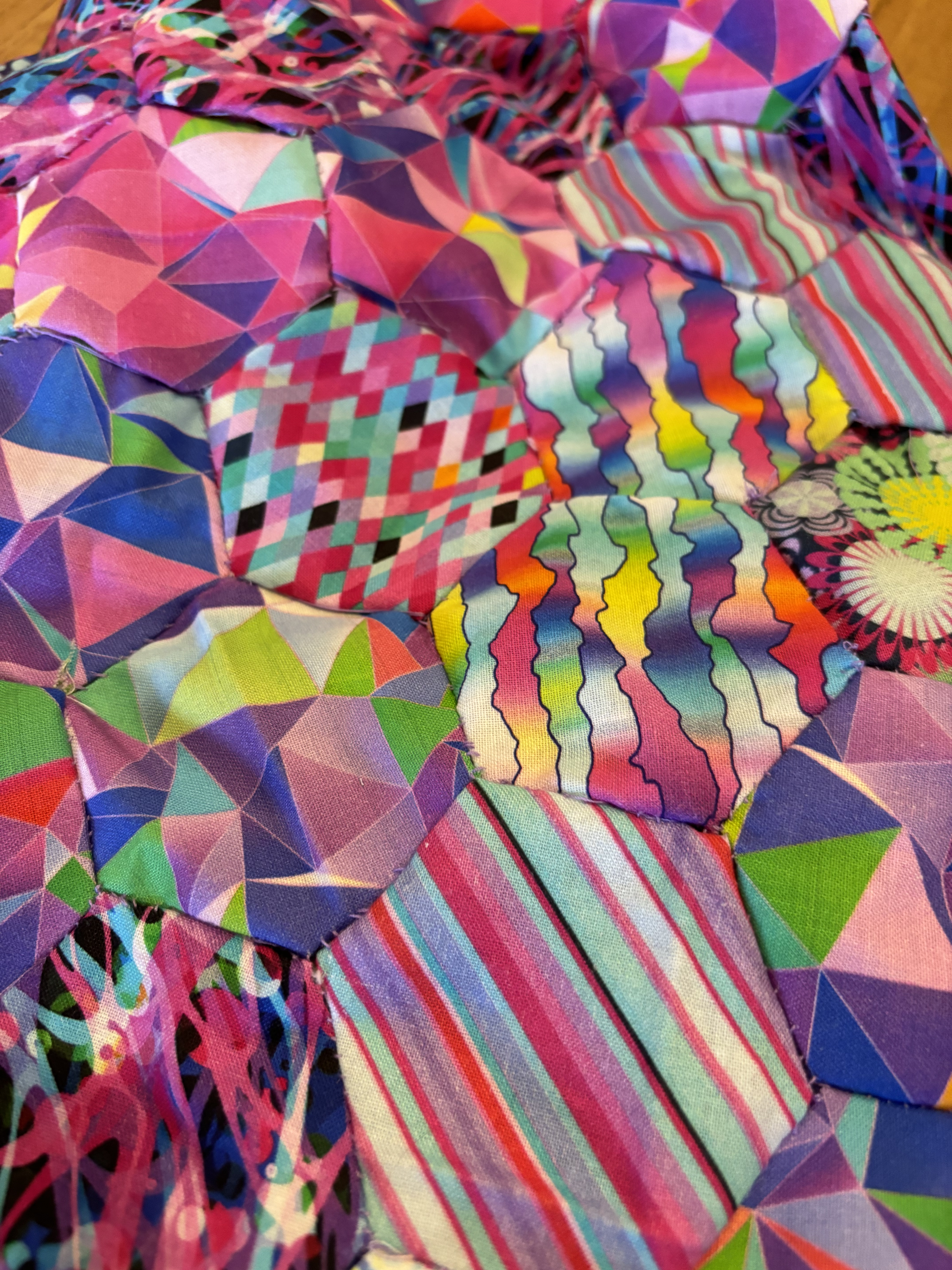
A close-up of the quilt, showing the small stitches the hold it together.
Let’s explore the trends of the quilt thus far. We answer a lot of questions as reference librarians, but reference transactions ebb and flow over the course of a semester. Week 2 was my busiest week for questions—first-year students found their way to the library and had questions about how it worked. Most of the questions I got that week were about printing (14 of 33 queries), which makes sense—it’s not intuitive how to print at our library.
Later in the semester, the questions shifted. Students had questions about how to find articles for their assignments. Many of those questions required research consultations. Weeks 6, 11, and 13 were especially busy, likely because the nursing students, our library’s biggest users among the student body, had major assignments due around those times of the semester.
Surprisingly, the last few weeks of the fall semester were not busy at all. Weeks 15 through 17 were quiet. I theorize that this is because research for final assignments was already done; students were now focused on writing, something librarians at FDU do not assist with. Questions I got the last weeks of the Fall 2024 semester were about more material things (how late are you open? can I have a pen? can you unjam the printer?) rather than complex research queries.
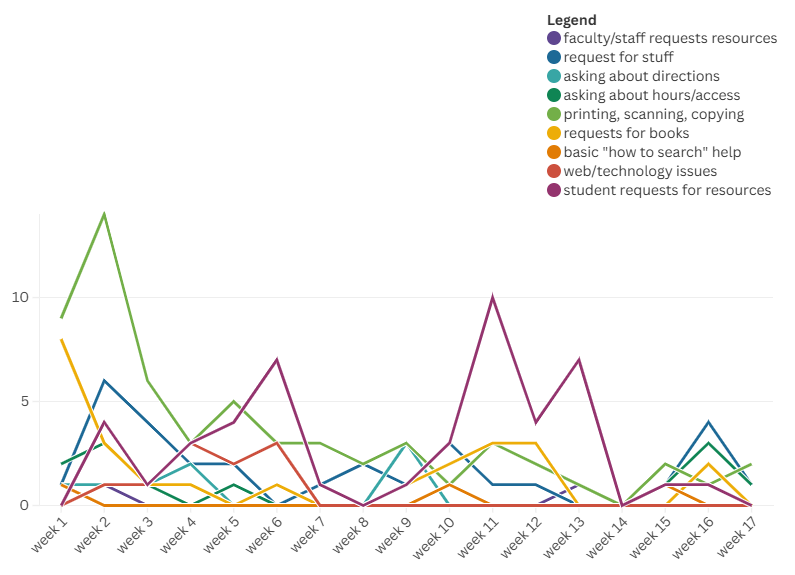
For an interactive version of this chart, click here.
However, a line graph like this one doesn’t do it justice. That’s why I am quilting. The specificity of the queries is lost in a graph. A quilt (one that’s wildly colorful and a little rough around the edges) allows you to zero in on a single data point, on one hexagon, on one question. The paper hexagons, which I am saving, serve as a complement to the fabric object.
And the fabric itself—simple cotton material—provides a tactile sensation that I can’t get from a graph. The quilt is tangible. It’s warm when I lay it across my lap to add another piece. I hope it’s something people can connect to when they see it. Something they can touch. Something that brings them clarity on the work librarians do.
Conclusion
I am a proud parent to this quilt. Even though my hands ache, it’s been such a good learning experience to create something chaotically beautiful. I mentioned earlier that my first time trying EPP put me into a meditative flow state. Everything left my head except fabric, paper, and thread. As I work through my reference quilt, I find myself focusing on fabric, paper, and thread again. But now I think of the question on the paper as I cover it with a corresponding fabric. I find myself remembering the person who asked, the time I took to answer it. It’s become a reflective process—one that I would not have if I added a reference transaction through our library’s system and never looked at it again.
The general consensus from viewers is that the quilt is a cool project, but opinions vary on whether or not it’s research. As librarians, we are all aware that research is a process as well as a result. I focus on the process here. Further, I argue that this quilt is research—that reflection on work done, that creative visualization of mindlessly-collected data, can too be research. I am connecting to the work I do in a way I had not envisioned. I am hoping that showing the quilt to other librarians evokes a similar response—one of reflection, connection, and understanding.
The project’s most effusive supporter was my partner’s grandmother, whom I showed the partially-done quilt in December 2024. She was delighted that it was hand-quilted. “That’s real work,” she said.
I will be taking the finally-completed quilt to the American Library Association Annual Conference in June 2025 as a non-traditional research poster. I am hoping it’s received well there. Above all, I hope the quilt does justice to the work we do as academic librarians—the work that we usually don’t see.

Erica Leslie Weidner
Erica Leslie Weidner is a Research & Instruction Librarian and Adjunct Instructor at Fairleigh Dickinson University. She is an early career librarian, longtime writer, and newbie quilter. Find more of her work at www.erica-leslie.com.