Since 2020, Mary Elizabeth Leighton and Kalea Furmanek-Raposo have been crafting encounters with humanities data together as literary scholars and in collaboration with university librarians. First, we worked together in a pandemic-era online undergraduate classroom as instructor and student, combining archival research in 19th-century digital databases with 19th-century hands-on scrapbooking practices. Second, we collaborated as part of the Crafting Communities team, researching and creating online DIY craft tutorials (with step-by-step written instructions, photos, and videos) on 19th-century craft practices. And third, we planned and piloted a fall 2024 English majors capstone seminar, teaching students about critical crafting methods–that is, how to use crafting as a way of deepening their understanding of literature.
This capstone seminar, titled “ENSH 482: Community-Engaged Learning and Public Humanities: Crafting Literacies,” was structured around three modules: paper, textiles, and printing. For each module, we invited community and scholarly experts into the classroom to teach students a range of crafting methods: for the paper module, students learned lino carving and block printing, paper quilling, and décollage; for the textile module, rag rugging, embroidery, and sewing; and for printing, typesetting by hand and hand press printing on our university library’s 1953 Vandercook press. We also invited librarian experts to teach us about creativity and book arts, how to edit audio with Audacity, and how to curate digital exhibits using Omeka. The seminar concluded with pop-up exhibits of students’ final crafted projects at our university library as well as a local public library; a month later, we launched Crafting Readers, complementary in situ library and digital exhibitions of students’ final crafted projects, which responded to the literary texts they had chosen, and their written and audio reflections on crafting as a mode of literary analysis.
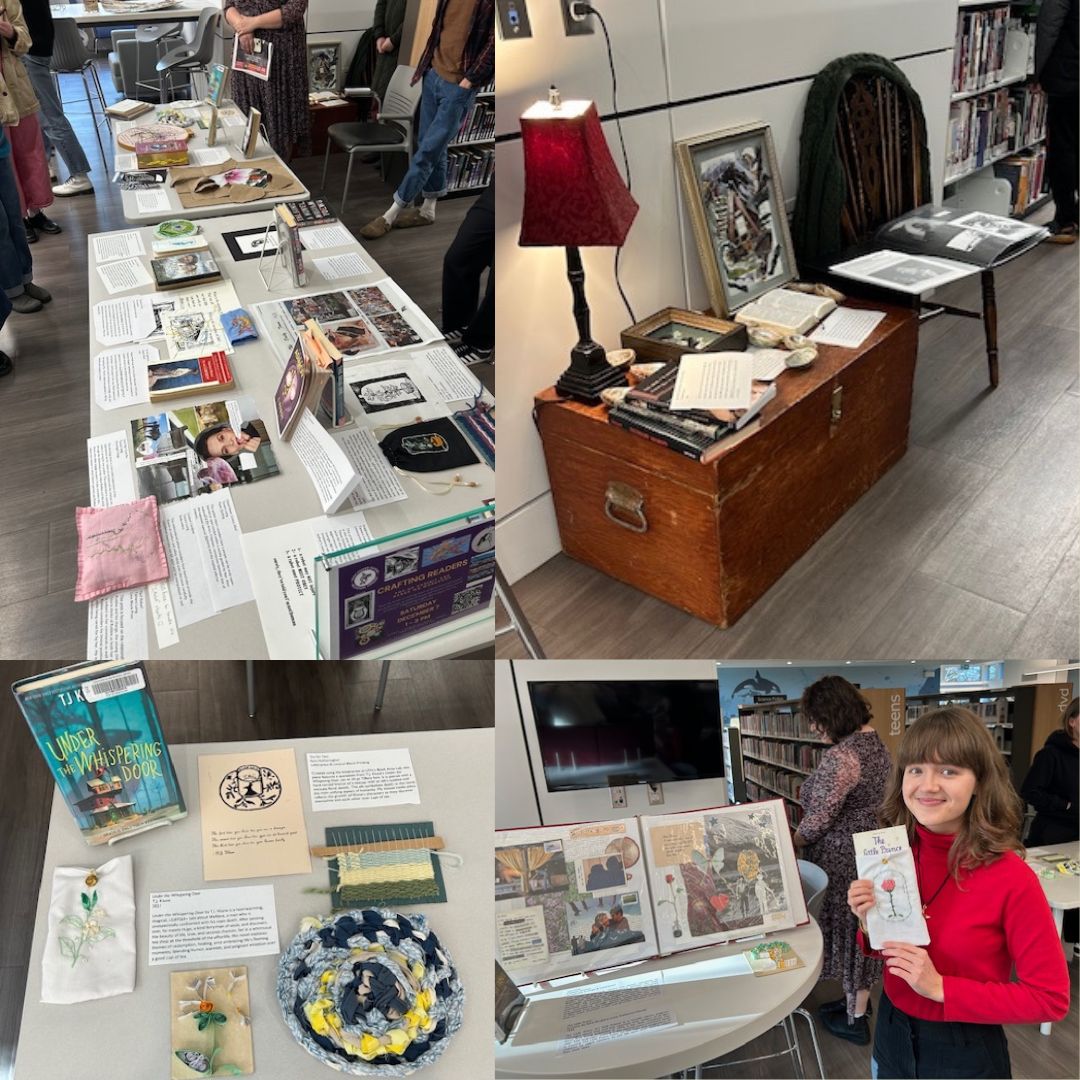
English capstone students at the “Crafting Readers” pop-up exhibit at the Sidney-North Saanich Branch of the Vancouver Island Regional Library on 7 December 2024
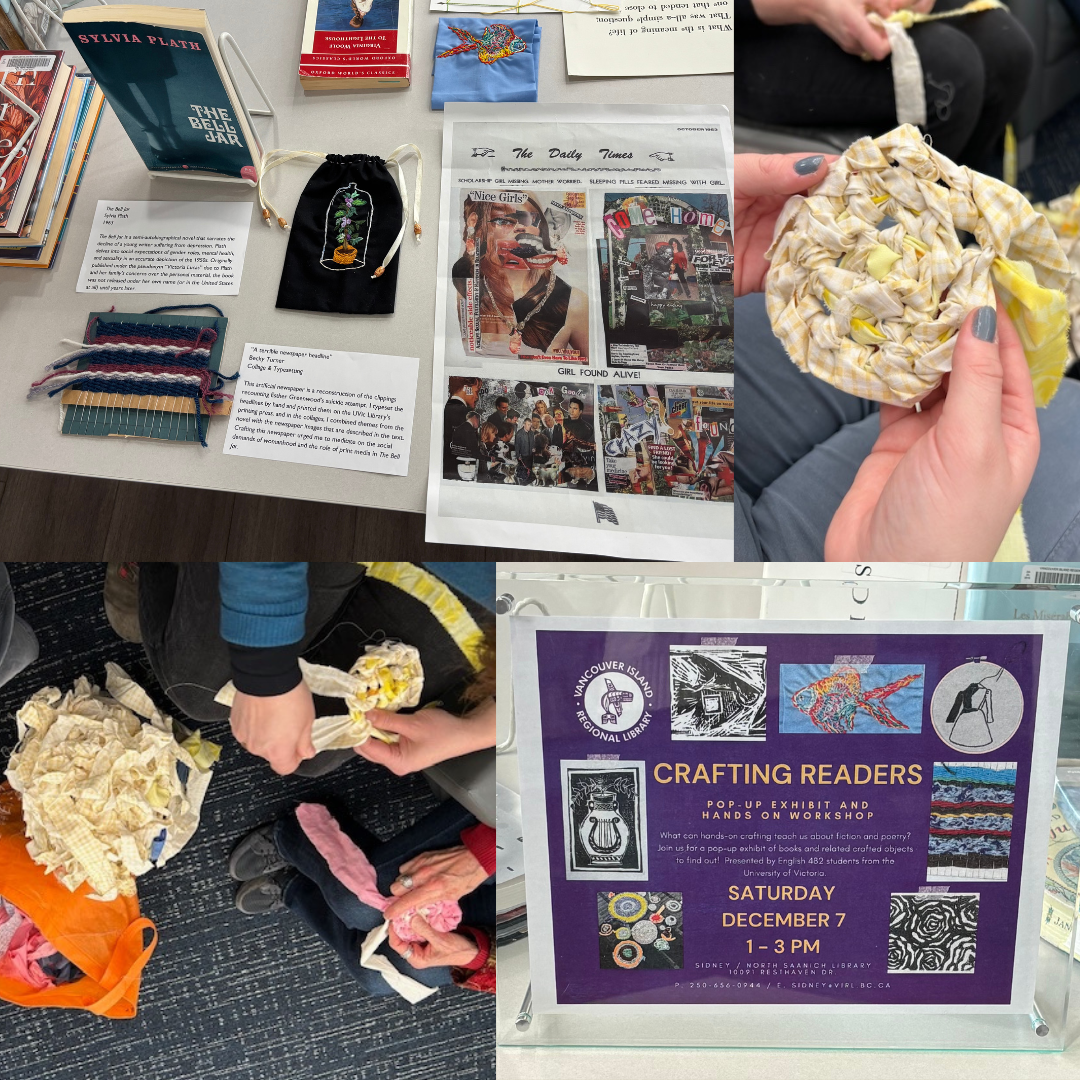
English capstone students’ final projects and rag rugging workshop at the “Crafting Readers” pop-up exhibit at the Sidney-North Saanich Branch of the Vancouver Island Regional Library on 7 December 2024
We recommend paper quilling as a productive classroom and library activity with rich potential for data visualization. We provide some background about the history of paper quilling before sharing our experiences of quilling in the literature classroom as well as some examples of capstone students’ quilling and reflections. Since that first capstone quilling workshop, we have adapted the workshop for a second-year foundations literature course, and we also include some examples of second-year students’ quilling. The pattern that we provide here has thus been honed for general use in the literature classroom through several iterations. We conclude by making recommendations about how quilling might prove fruitful for students working with library materials regardless of their academic discipline.
Paper Quilling: A Brief History
Paper quilling (also called paper filigree, paper mosaic, mosaicon, or rolled paperwork) exists in various forms across time and space. For example, Jianzhi, or Chinese paper cutting, dates back to the second century and informs the style of Chinese paper quilling, which usually focuses on contrast and blank space (Ding 21-22). The earliest evidence in Western traditions comes from churches, nunneries, and monasteries scattered across Europe (Williams), where fifteenth-century nuns and monks used quilling in place of metal filigree (that is, precious metalwork). However, the exact origins of paper quilling are unknown, and the craft may be as old as the creation of paper itself.
When paper quilling, the crafter manipulates long strips of paper into spirals with a thin tool and then applies an adhesive to the paper coils to stick them onto a surface. Long strips of paper can also be left uncoiled and glued along their edges for structure as the crafter creates a three-dimensional design. Changing the color of the paper strips and the size of the tool used to roll the paper gives the design shape and texture. Paper quilling requires few materials or special equipment and lends itself well to upcycling, making it a popular craft throughout time.
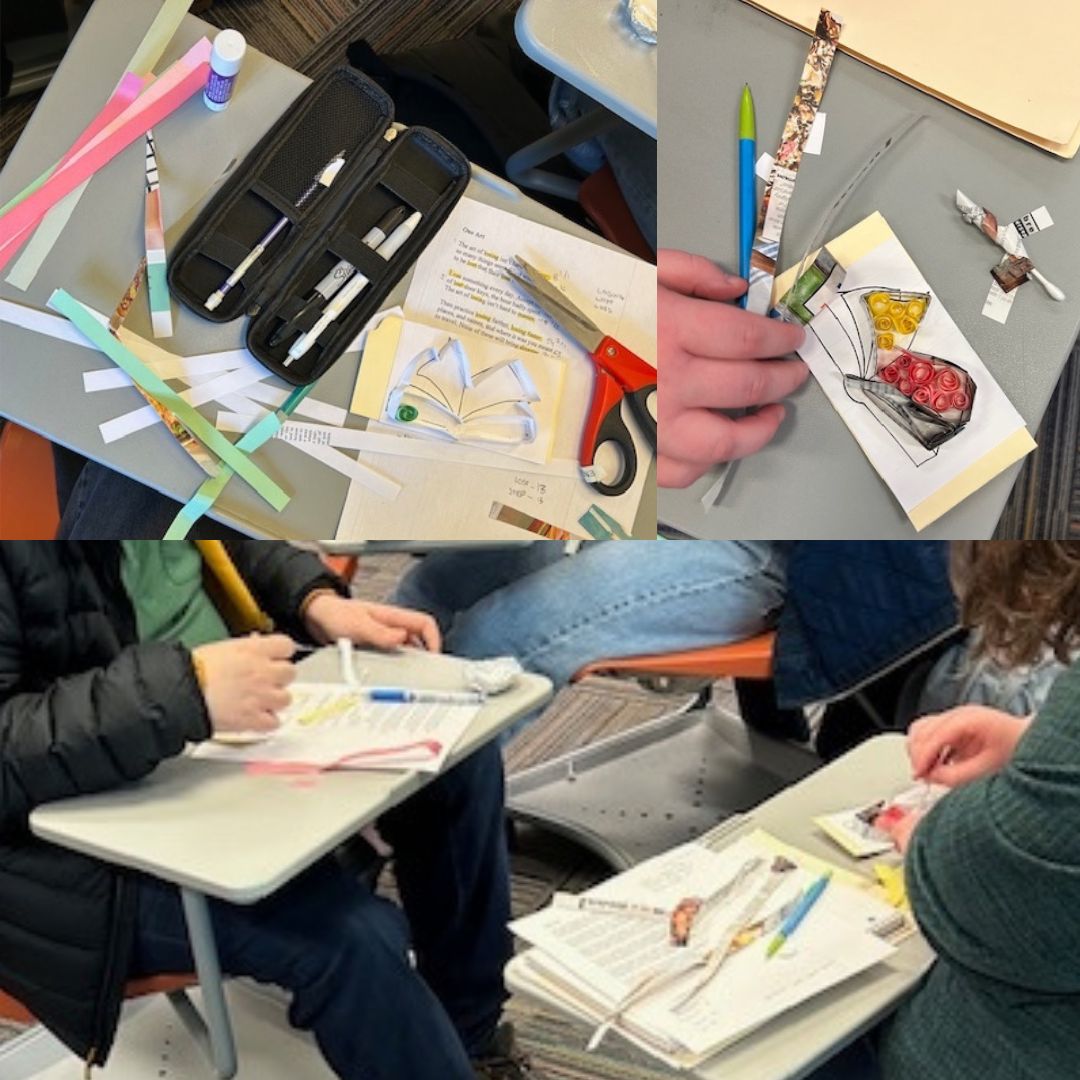
English foundations students’ paper quilling
Extant examples of paper quilling appear on everything from mirror frames to tea caddies now housed in museums (Battison). Quilling became a fashionable pastime for women in the eighteenth century. A 1786 article in the New Lady’s Magazine speaks to the versatility of this craft: “[paper quilling] affords an amusement to the female mind capable of the most pleasing and extensive variety” (530). Today, paper quilling most frequently appears on greeting cards but has great potential as a method of data visualization.
Paper Quilling in the Classroom
We have experimented twice with paper quilling in undergraduate literature classrooms: first, in the capstone seminar for English Majors that we have already described and that focused on what crafting methods can teach students about literary texts; and second, in an introductory foundations course for English Majors focused on building students’ literary-critical vocabulary, strengthening their literary analysis, and honing their prose. After our first classroom workshop in the capstone seminar with upper-year Majors, we adapted the workshop for first- and second-year Majors in the foundations course, integrating lessons we had learned about workshop planning and delivery as well as implementing a clearer focus on quilling as a data visualization exercise.
By the time we piloted our first paper-quilling workshop, Kalea had already developed a paper quilling tutorial for the Crafting Communities website as part of her graduating M.A. project. Drawing on historical and contemporary sources, she compiled a list of steps and materials—including a range of paper and tool options to make the tutorial accessible to a range of makers in a range of settings. To test this pattern and demonstrate how paper quilling can be incorporated into literary analysis, Kalea created a large paper eye to represent the concept of narrative perspective in Charlotte Brontë’s Villette, which is a novel thematically preoccupied with what is seen and what remains unseen. She noted how many times specific eye colors (blue, green, brown, and violet) were mentioned in the text, using the Project Gutenberg digital edition to search for terms relating to eyes and tracking their frequency in a spreadsheet. The creation of searchable editions of novels enables efficient data-based analysis, and we encourage workshop participants to seek out such resources.
Per each mention of an eye color, Kalea quilled three strips of paper in the corresponding color. These paper rolls filling in the iris of her eye act as data that visualize the protagonist’s attention to detail. Scholars have theorized about the function of Villette’s secretive and unreliable first-person narrator (Lucy Snowe) since the novel’s publication. Despite the pseudo-autobiographical mode, the protagonist often withholds information about the plot and other characters from the reader. Kalea demonstrated how Lucy’s attention to detail—specifically, whose eyes she notices, how often she describes their eyes, and whether or not the adjective that she uses to describe them changes as her relationship to that character evolves—betrays the very information about her personal life that she strives to conceal from the reader. Through her paper quilling work, Kalea concluded that Villette’s unique combination of detail and concealment cleverly resists the nineteenth-century gender roles prohibiting explicit expressions of female feeling.
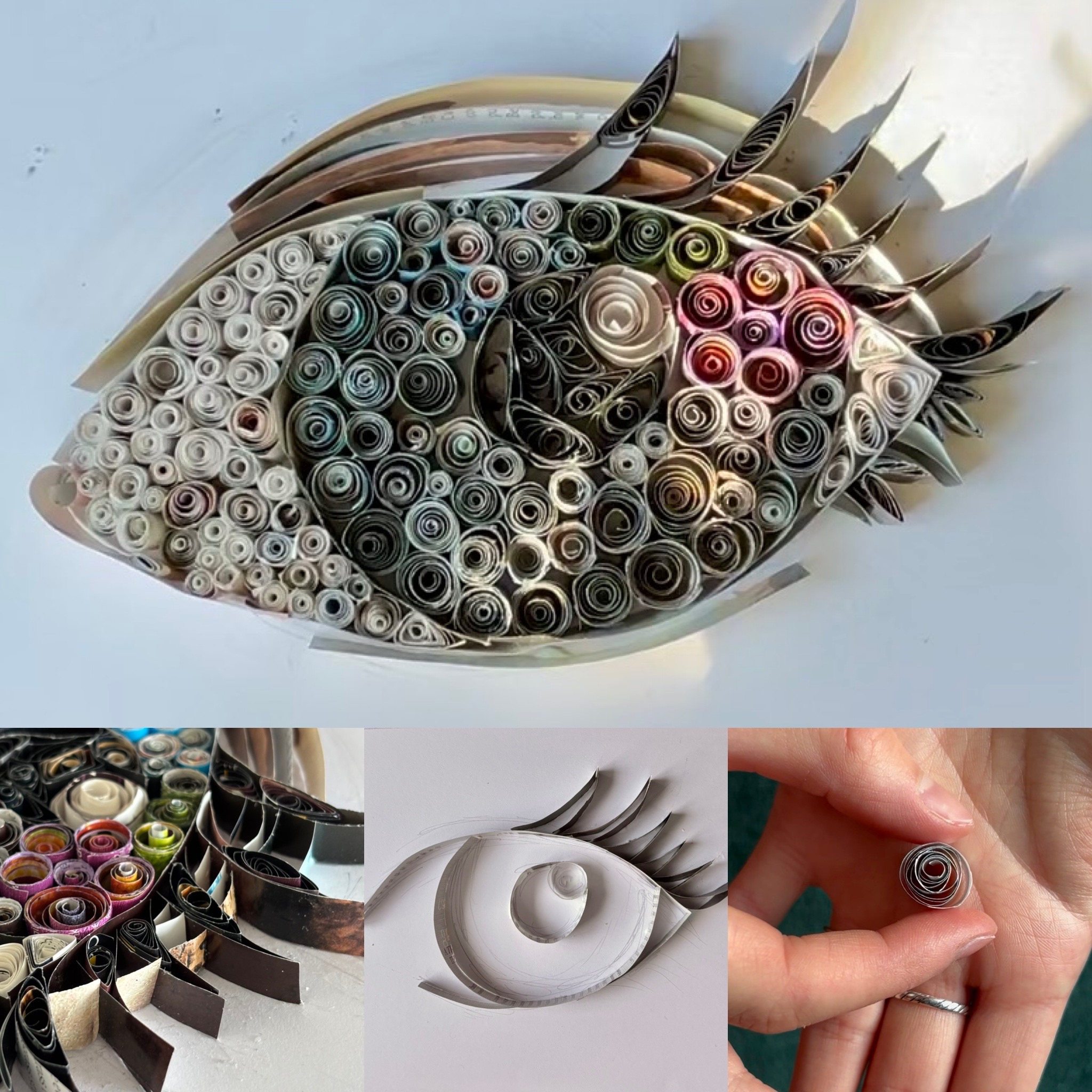
Kalea’s paper-quilling project on Charlotte Brontë’s Villette
Paper Quilling in the Classroom 1: Capstone Seminar
We used Kalea’s tutorial to devise our paper quilling workshop for the capstone class. For this workshop, we provided and prepared the materials: pre-cutting strips of colored paper using a paper-cutter, providing a heavy paper base, and pouring liquid glue into small recycled containers. However, each student chose and brought their own design connected to the literary text that they worked on throughout the course. During the 80-minute workshop, students transferred their design to a paper base, outlined their design by building sturdy paper walls, rolled paper coils, and quilled their design by filling in the paper walls with rolled paper coils.
We presented paper quilling as a potential mode of data visualization, emphasizing how Kalea’s quilled eye incorporated data about narrative perspective that she gathered from Brontë’s novel, yet students engaged with this craft in mainly aesthetic and thematic rather than data-driven ways. Encouraged to choose their own design, students tended to pick objects that were mimetically represented in their literary texts (such as water flowing over rocks at the shoreline in a novella set on California’s coast) or metonymically related to their literary texts (such as a lamp in a poem about home and domesticity). Despite this design focus on representing objects that appeared in their literary texts, the following students’ reflections suggest how the quilled design became a way of visually representing complex relations in the literary text (among characters, settings, themes) and how the act of paper quilling became an analogy for—and, indeed, facilitated—the act of criticism by drawing attention to literary aspects of their text.
English Capstone Students’ Paper Quilling and Reflections
Carly Goodman on Christine de Pizan’s The Book of the City of Ladies (1405)

Carly Goodman on Christine de Pizan’s The Book of the City of Ladies (1405)
“In The Book of the City of Ladies, Pizan writes of a ray of light that comes to her in a moment of devastation, appearing first as the sun but revealing itself to be “three crowned ladies” coming to bring her enlightenment. Deceptively difficult, I found paper quilling to be a rewarding task. Though the slightest deviation in size, color, or placement of the paper coils threatened to ruin the illusion of the image, I realized that this papercraft merely demands patience and a willingness to adapt, much like Pizan’s perception of her coming struggles and the role the women would play in her overcoming them. Through perception, the sun becomes a symbol of resistance, change, and female empowerment.”
Kyra Hetherington on T.J. Klune’s Under the Whispering Door (2021)

Kyra Hetherington on T.J. Klune’s Under the Whispering Door (2021)
“I chose to quill a dandelion while reflecting on T.J. Klune’s Under the Whispering Door because the flower represents hope, healing, and resilience and marks the start of the main character Wallace’s journey in character development. Quilling relies on creating firm foundation walls while leaving space for intricate details and patterns that rely on tension and delicacy. The same can be said for character development in Klune’s novel. Wallace’s initial description takes the place of the stem and leaf walls, giving the reader an idea of the character. Closed loose coils in my dandelion serve as representations of the many relationships and events that Wallace experiences. This internal shaping gives the final quilled flower more depth and complexity, just as Wallace changes from a flat, mean character into a person who craves the possibilities of what life can offer.”
Faith Lapointe on Virginia Woolf’s To the Lighthouse (1927)
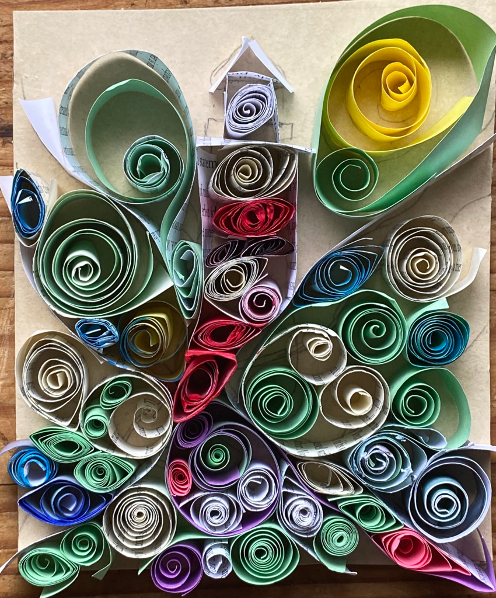
Faith Lapointe on Virginia Woolf’s To the Lighthouse (1927)
“Like Virginia Woolf’s novel To the Lighthouse, paper quilling relies on small details coming together to form a larger cohesive image. The process of paper quilling–which involves choosing, cutting, rolling, and arranging strips of paper to create a design– illuminates Woolf’s prose style. She builds the novel by intertwining fragmented streams-of-consciousness to layer characters’ perceptions and reflections, a strategy that draws attention to the insight that can be found in small, seemingly insignificant moments while also demonstrating how life itself is composed of and defined by such moments.”
Tamara Laing on Isaac Asimov’s I, Robot (1950)

Tamara Laing on Isaac Asimov’s I, Robot (1950)
“The colors of paper provided an opportunity for color-play…. While the coiled spring in the center of the gears is made of a neutral black-and-white print stock and thus reads as more ‘mechanical’, the outer gear has the appearance of a yellow flower that speaks to the way the robots most often engage with the humans: they try to work with them rather than in opposition. There are three pink open-topped hearts, which gradually increase or decrease in size depending on the viewer’s perspective and represent the Three Laws of Robotics in the novel that exist to keep humans safe from robots but also distinctly ‘other’ them…. Connecting the gears and the hearts is a gear heart made of neutral text strips. It is engaged with the gears as well as following the shape of the heart and is meant to connect the two elements that are forever at odds in the book. I opted not to follow the traditional technique we were shown, which involved building frame walls and filling them with quilled curlicues and the like. The end result is a piece that rejects rigid rule structures while inviting touch and evoking a sense of play.”
M.L. Prenger on Elizabeth Smart’s By Grand Central Station I Sat Down and Wept (1945)
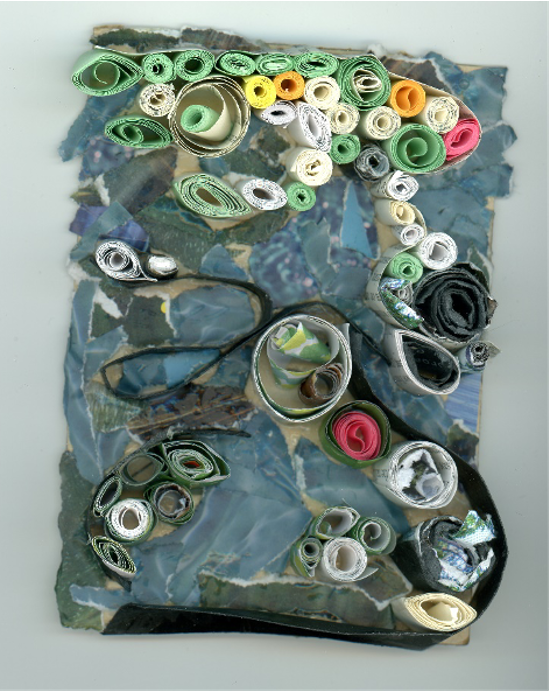
M.L. Prenger on Elizabeth Smart’s By Grand Central Station I Sat Down and Wept (1945)
“There is purposeful chaos to Smart’s writing: the fragmented prose reflects and amplifies themes in the novel. I was unsure how to approach the text, but one line stuck: “The sea booms. The stream rushes loudly … the kelp in amorous coils appear to pin down the Pacific.” The contrast of delicate curling and unfolding (wavering) kelp beds holding down something as vast and uncontainable as the Pacific is what I wanted to capture in the coils of my paper quilling. I chose to be unprepared, without form to trace. I scratched some squiggles in pencil and felt ashamed of how childlike they appeared. I wanted to sit and spin paper, thinking about the ocean itself (its proximity, my feelings while observing it). The coiling kelp beds suggest a delicate balance between control and surrender, reflected in Smart’s writing but also within myself. Apprehensive to attempt something new, I hoped my intention would move through my fingers, winding the paper strips up with my desires, my entanglement (and history) with the text…. The novella affords Smart emotional release but never resolves the issue of love, loss, and longing. Likewise, my coiled paper forms are holding down the rising swell of opposition within, allowing me to touch that tension point and use a dab of glue to hold it in place.”
Ria Sheoran on Hanya Yanagihara’s A Little Life (2015)
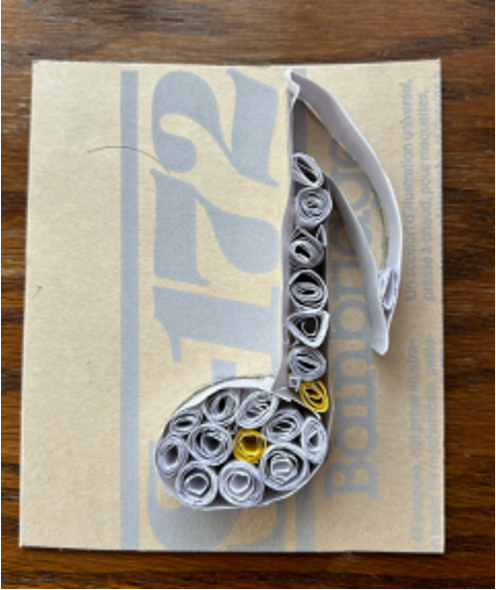
Ria Sheoran on Hanya Yanagihara’s A Little Life (2015)
“Through paper quilling, I was able to conceptualize the intricate coils of each relationship that the main character Jude in Hanya Yanagihara’s A Little Life nurtured. Not every coil of paper was easy to create for this project, and at times the coils fit uncomfortably against the other pieces of paper. This, in turn, enabled me to think that even though these relationships were what shaped Jude’s life, they were not always providing what was best for him despite being necessary to his story.”
Melanie Turunen on Antoine de Saint-Exupéry’s The Little Prince (1943)
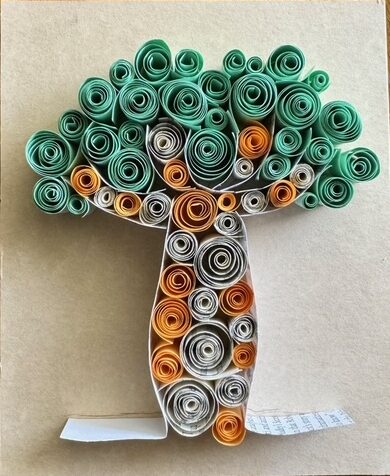
Melanie Turunen on Antoine de Saint-Exupéry’s The Little Prince (1943)
“Reflecting on my experience of paper quilling a baobab tree from The Little Prince by Antoine de Saint-Exupéry, I found that the craft mirrored the novella’s deeper themes of care and growth. The baobab trees in the story are a powerful symbol of the consequences of neglect. The Prince’s task on his asteroid is to prevent the baobabs from growing too large and overwhelming, much like how we must care for the things and people we love. The tightly wound strips of paper in my baobab tree, requiring close attention and care to prevent unraveling, became a visual metaphor for the need to nurture what we cherish before it grows burdensome. Just as the paper could easily tear or loosen if not carefully applied, so too can the delicate aspects of our lives unravel if not given the attention they need. The Prince’s love for the Rose, his companion, only grows once he understands that he is responsible for her and nurturing their emotional relationship. Each twist and turn of the paper was a gentle reminder of how important it is to tend to the small details—whether in art or our lives—so that they can flourish without becoming overwhelming.”
Paper Quilling in the Classroom 2: Foundations Class
After the first workshop, we realized that if we wanted students to use paper quilling as a data visualization method, we needed to prompt them explicitly to prepare a data set ahead of time. For our second workshop, with junior students in the second-year foundations class, we focused students on data visualization by 1) providing everyone with the same literary text, Elizabeth Bishop’s “One Art” (1976),) and the same design, an image of an open book; and 2) requiring students to assemble a data set before they started quilling.
To model paper quilling with a data set from a literary text, we shared not only Kalea’s quilled eye based on her analysis of Villette but also samples that she had prepared based on her analyses of two poems: Eavan Boland’s “The Pomegranate” (1994) and Theodore Roethke’s “My Papa’s Waltz” (1942), which students had discussed in a previous class.
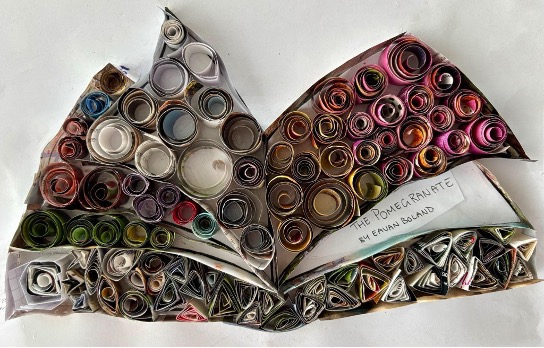
Kalea Furmanek-Raposo on Eavan Boland’s “The Pomegranate”
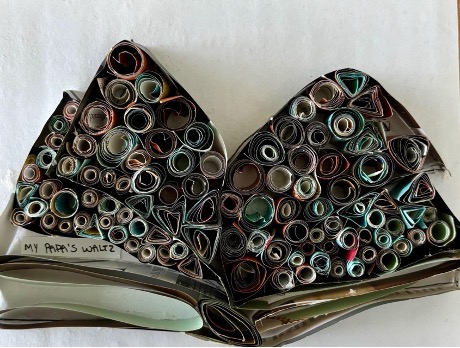
Kalea Furmanek-Raposo on Theodore Roethke’s “My Papa’s Waltz”
Kalea’s samples (seen above) focus on meter. In her paper quilling of “The Pomegranate,” each colour represents a number of syllables in a line (e.g., there are five lines with eleven syllables represented by the five green coils). Kalea divided the stanzas in “My Papa’s Waltz” into each section of the pattern and then used pink coils to represent stressed syllables and blue coils to represent unstressed syllables. She glued them in rows that loosely replicated the poem’s lines and marked the ending syllable of each line with a triangle.
For this second workshop, we built in time for students to gather data in small groups before launching into quilling. We gave each group a few minutes to assemble their data set. As the class had discussed in a previous class on poetry and closed form, “One Art” takes the form of a villanelle, with five tercets and a quatrain as well as a tight rhyme scheme and pattern of repetition. (For example, in a villanelle, the first line of the first tercet repeats as the third line of the second tercet.) The poem thus provided students with useful options for data collection.
Kalea’s samples focused on meter, but some students chose to count words relating to the poem’s key themes. They then rolled the corresponding number of paper coils and used different shapes to identify them, as in the following example.
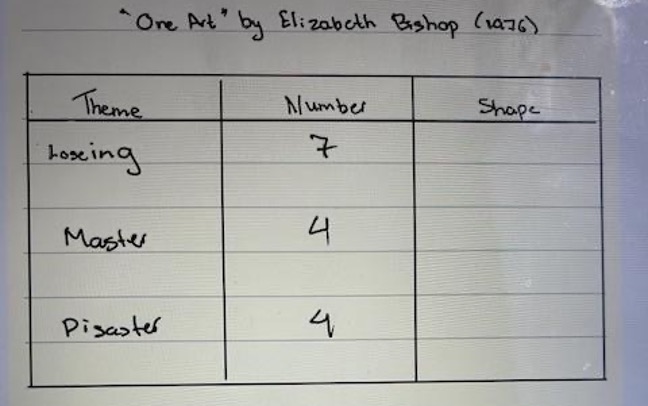
Data chart for paper quilling by Cerine Chittattu and Fermín Roja
English Foundations Students’ Paper Quilling and Reflections

English foundations students’ paper quilling samples by (top to bottom, L to R) Julia Apap, Cerine Chittattu, Olivia O’Leary, Wesley Oertel-Sproule, Dallia Knight, Isabelle Porter, Sage Stobbe, Abi Heinrichs, Sienna Sabina, Jake Rees, Fermín Roja, Ruby Lautermilch, Cynthia Guo
We built in time for students to talk briefly in their small groups and then as a class–at the beginning of the workshop, about their data, then at the end of the workshop, about how the paper quilling process helped them visualize these data. For example, students who focused on diction and repetition noticed the number of times that references to (and variants on) loss appear in the poem; they noted not only repetition of the word losing but repeated variants on this word, including lost, lose, and loss. Other students counted caesurae, enjambed lines, and rhyme. Would students have noticed such poetic elements without paper quilling? Hopefully–but the acts of preparing data and paper quilling these data underscored the relationship of poetic form to theme, and the different visualizations within the same open-book design suggested the poem’s formal complexity.
Recommendations:
-
Data Assembly: Invite students ahead of time or during the workshop to assemble the data that they will visualize in the form of paper quilling. A short poem provides ample data for a single workshop. Longer fiction and non-fiction would also provide useful data, but students might need more time to assemble such data. Project Gutenberg is a useful resource for students working on literary texts that are available in HTML format because of such texts’ searchability using keywords. For example, Kalea searched the Project Gutenberg version of Villette using keywords to determine the number of occurrences of eye color in the text. Paper quilling could be adapted for non-literary forms of data as well.
-
Paper Quilling Materials: Assemble and prepare quilling materials ahead of time: paper strips (in different colors) that measure the same length; cardboard or stiff paper bases; copies of the same pattern; stick glue (for gluing the paper pattern onto the base) and liquid glue (for attaching paper coils to the pattern on the base).
-
Reflection Time: Build in time for reflection and take-aways, either as part of a workshop discussion or as a check-in after the workshop.
Pattern
Supplies:
- Paper (colored paper, newspaper, magazine pages)
- Cardboard or heavy paper for the base
- Scissors, knife, or metal ruler
- Large paper clip
- Glue stick
- Liquid glue
- Small brush or cotton swab to apply the liquid glue
- Container for liquid glue (optional)
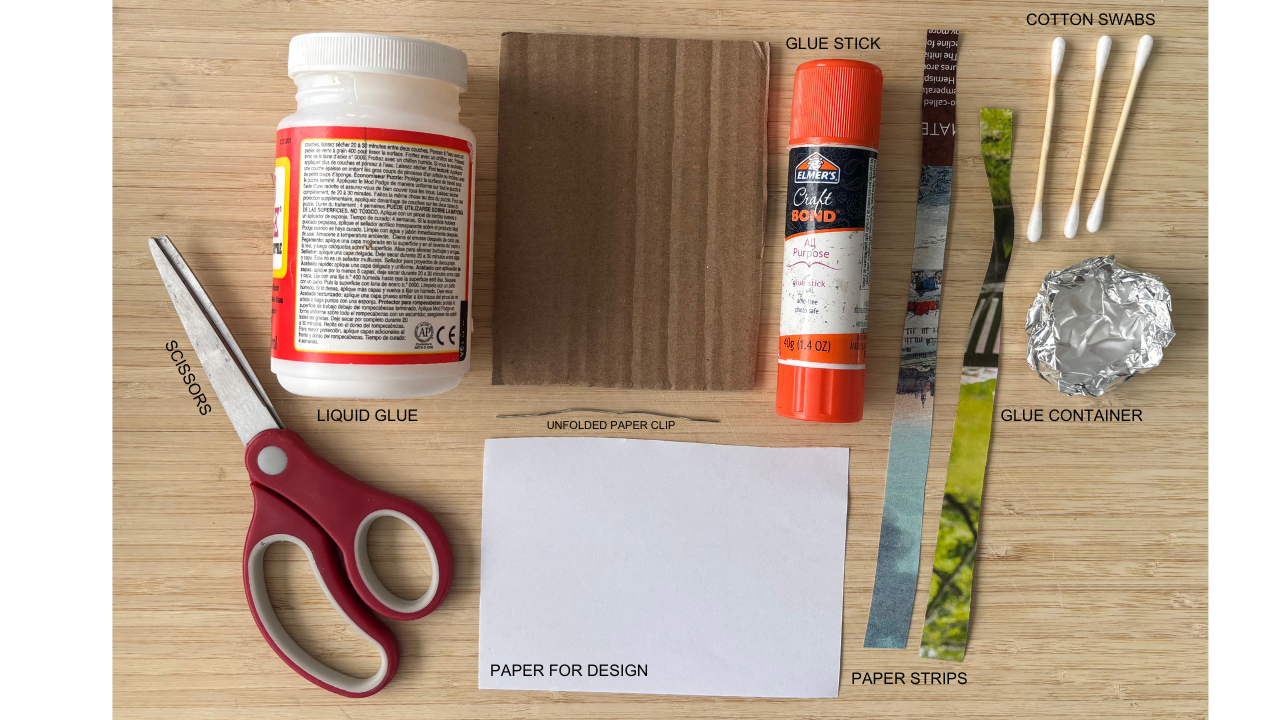
Paper quilling supplies
Step 1: Preparing the materials
Cut the paper into strips along the long edge so that each strip measures approximately 1 centimeter (1/3 inch) in width. If you have access to a paper cutter, we recommend using it to cut the paper into uniform strips.
Print copies of a common design to be glued onto the base (or bring a copy of your own design). We recommend keeping designs for classroom use compact because of time constraints. We chose this image of an open book, which Kalea drew and which measured approximately 6 centimeters (2.5 inches) wide and 4 centimeters (1.5 inches) tall.
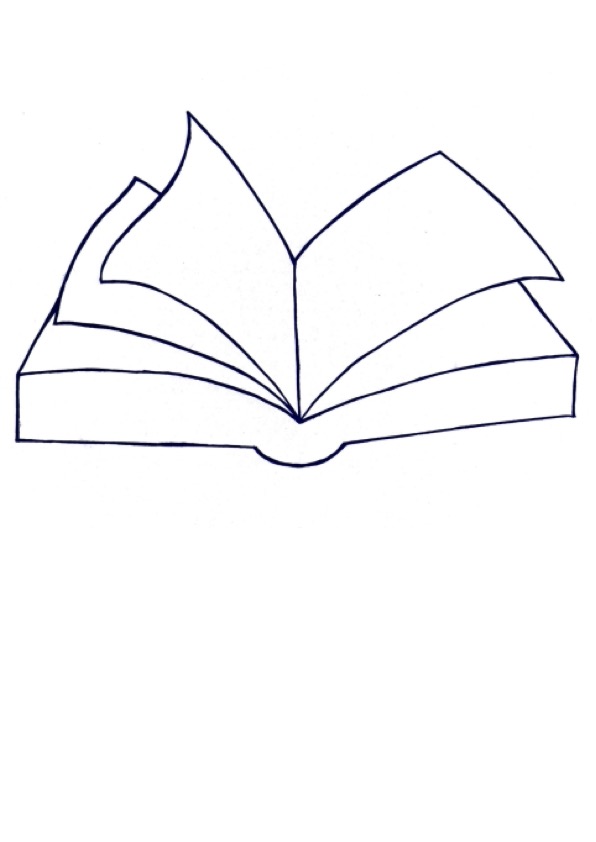
Kalea and Mary Elizabeth’s paper-quilling pattern for workshops
Pour liquid glue into containers for sharing. We made small trays out of aluminum foil.
Unfold your paper clip to create a makeshift quilling tool around which you will coil your paper strips. (We found it easier to keep the coils taut when rolling them around such a tool instead of using our fingers.)
Step 2: Determine your data set
Choose something to visualize with your paper quilling. We encouraged students to plan their paper quilling using data-informed decisions.
Step 3: Creating the design
Glue the printed design on your base with a glue stick (or, in the alternative, draw your design on the base with a pencil). Do not use the liquid glue for this step because it will make the base soggy.
Create an outline of your design by placing some of your strips of paper on the base (they should be standing upright like short walls) and gluing them down with the liquid glue. You will fill in these borders with your curled strips later.
Step 4: Begin your quilling!
To form the paper coils, place a strip of paper at the base of your paper clip and roll it onto the tool (or just use your fingers). Once you have rolled the whole strip, press your thumb to the loose end of the strip and slide it off your tool. Roll the paper between your fingers to tighten it or let it spring open for a loose coil. You now have a circular paper roll. You can shape this roll into another shape by pinching the edges or glue down the loose end to keep it circular.
Glue the paper rolls within your pattern’s walls until you have completed your design.
You can explore Kalea’s short videos on coiling techniques to learn more.
Works Cited
Battisson, Clair. “‘Natural Born Quillers’ – Conservation of Paper Quills on the Sarah Siddons Plaque Frames” Conservation Journal, no. 27, April 1998. V&A.
Ding, Eva. “Jianzhi: A Silhouette of Tradition, Art, and Feminism Through Chinese Paper Cutting.” Scope: Contemporary Research Topics (Art and Design), no. 26, 2024, pp. 21–33.
“Historical Account of the Origin and Progress of Paper Filigreework, with an Accurate Description of the Present Practice of That Ornamental Art.” New Lady’s Magazine, vol. I, no. 10, Nov. 1786, pp. 529–30.
Williams, T. C. “Paper Gold: The History and Art of Paper Quilling.” Medium, 15 Feb 2022.

Dr. Mary Elizabeth Leighton and Kalea Raposo
Mary Elizabeth Leighton teaches Victorian literature and culture at the University of Victoria. With Lisa Surridge, she co-wrote The Plot Thickens: Illustrated Victorian Serial Fiction from Dickens to Du Maurier (2019) and is currently researching pregnancy in Victorian fiction and culture. With Andrea Korda and Vanessa Warne, she co-founded Crafting Communities, a resource hub about 19th-century craft and material culture. Kalea Furmanek-Raposo holds an MA in English from the University of Victoria. Her research interests include nineteenth-century girls’ print culture and women’s writing as well as hands-on learning and digital humanities. She has been a part of the Crafting Communities team since 2021, she was a research assistant on the Great Expectations Pregnancy Project, and she was a 2023 UVic Lowens Fellow.